|
|


- This event has passed.
Beyond latkes! A Sephardi Hanucah
9 December 2025 @ 7:30 pm - 9:00 pm

Tuesday 9 December 2025, 7:30 pm UK; 8:30 pm Europe, 2:30 pm ET.
Hanucah this year begins on 14 December and lasts for eight days. Because the festival commemorates how the oil in the Temple lasted miraculously for eight days, it is customary for Jews to eat fried foods. Ashkenazim indulge in latkes and jam doughnuts, but Sephardim indulge in a rich variety of different fried foods. Raquel Levy-Toledano from Morocco, Viviane Bowell from Egypt and Linda Dangoor from Iraq will each share a favourite Hanucah recipe. They will talk about how the festival was celebrated in their country of birth. Recording here.
From left: Viviane Bowell, Linda Dangoor and Raquel Levy-Toledano
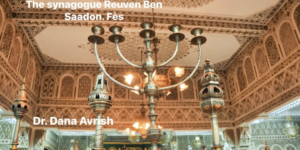
The main photo is of Moroccan sfenj



In order to receive Zoom details of this event you must be subscribed to the Harif mailing list, or write to info@harif.org
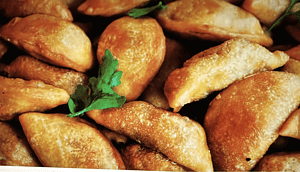
Sambusak bel tawa
Chickpea Pillows
These deep fried lovelies are one of my favourite snacks and no Iraqi cook’s repertoire should be without them. They are a standard offering at parties and gatherings. Traditionally, the filling is a mixture of chickpeas and chicken, but I prefer to make it with just the chickpeas. Note that the chickpeas must be soaked overnight in some lightly salted water to soften them. (Makes 35 pillows)
The dough
Chickpea water
200g self-raising flour
1 tablespoon olive oil
1 teaspoon salt
The stuffing
500g chickpeas
3 or 4 large onions, finely chopped
125ml olive oil
2 teaspoons ground cumin
1 heaped tablespoon curry powder
Salt and pepper to taste
Method: Wash the chickpeas and soak overnight in some lightly salted water. The next day, place chickpeas with their soaking water in a saucepan, cover with more water, if needed, and bring to the boil. Once boiling, reduce the heat to medium. Continue to cook, half covered, for about one hour or so. The chickpeas should be soft. Drain and reserve the water, you will need it for the dough.
Making the dough: Mix the dough ingredients with a little of the chickpea water whichwill act like yeast. Wet your hands and knead into a soft paste or mix in a blender, adding more chickpea water, little by little, until you reach a malleable consistency. Cover the bowl with a plastic bag orcling film and let it rest for about 30 minutes.
Making the stuffing: Meanwhile, coarsely mash the chickpeas (you can do this in a blenderor with a potato masher) and set aside. Fry the chopped onions in the oil until golden. Reduce the heat to low and stir in the chickpea paste. Add the curry powder and cumin, and mix well. Adjust salt and pepper to taste. Set aside.
Making the pillows: You will be cutting circles of dough of about 8cm in diameter. You can use a cookie cutter or drinking glass for this purpose. Roll out a small quantity of the dough with a rolling pin. The dough should be thin, about 6mm thick. Cut a few circular shapes at a time, out of the dough. Place a tablespoon of the stuffing in the middle of each circle. To ensure that the dough doesn’t open while frying, dab some water on one side.Fold over the other side to make half a circle. Press down the edges firmly and set aside on a tray. Continue until you finish the dough. In a large pan, put enough oil to deep-fry the pillows on medium heat. It is better to fry them in batches as it gives them room to expand. Fry until crisp. Transfer on to kitchen paper to absorb any excess oil.
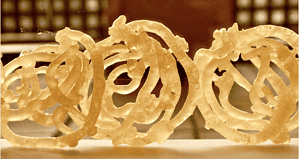
Zingoola or Zlabia
Famous Baghdadi sweet
These quirky looking sweets are popular in the Middle East and all over the Indian continent. One could have them during Hanukkah instead of the usual doughnuts or other fried dishes.
The batter
125g flour
About 180ml lukewarm water
2 teaspoons corn flour
1 teaspoon instant dry yeast
½ teaspoon oil
2 tablespoon yoghurt (optional)
½ teaspoon sugar
A pinch of salt
The syrup
800g sugar
400ml water
1 teaspoon lemon juice
2 tablespoons rosewater
You will need a piping bag, or a plastic ketchup bottle or the like. Mix the yeast in a little water, cover and set aside for about 20 minutes.
In a large bowl, mix the flour, corn flour, dry yeast, salt and sugar. Add the yogurt and mix well to remove all the lumps. Mix in the oil. Add a little water and mix. You need to add the water a little at a time until you achieve a thick pouring batter, the consistency of a thick single cream. Cover the batter and set aside for 30 minutes.
While the batter is fermenting, make the syrup.
In a heavy-bottomed pan, tip in the sugar, add the water, stir to dissolve the sugar and bring to the boil. Once the water boils, reduce the heat to medium-low and simmer for about 5 minutes or so. Add the lemon juice and simmer for a minute or so. Add the rosewater and simmer for another minute, or until the mixture becomes a little thick and sticky.
Now, uncover the batter and give it a good stir. Fill the funnel or plastic bottle with the batter.
In a wide heavy-bottomed pan, heat up some oil for deep frying. Once the oil is very hot, reduce the heat to medium and start squirting the batter into the oil. With very quick circular motions, start making circles and loops. Once you finish one circle, start another. Fry both sides until golden. Carefully remove out of the oil and dip into the syrup.
Arrange on a plate in one layer. Once the Zingoolas have cooled down, you can pile them one on top of the other.
Linda Dangoor is the author of Flavours of Babylon
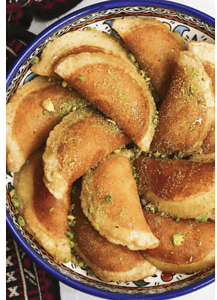
Atayef
Middle Eastern stuffed-pancakes
Atayef (also called qatayef) is an ancient Middle Eastern dessert. Its origins can be traced back to the Abbasid Caliphate (750-1258 CE). The earliest known reference to atayef appears in a 10th-century Arabic cookbook called Kitab al-Tabikh, The Book of Dishes. One theory suggest that a chef created the dessert for a Caliph who wanted a rich, filling treat that would sustain him for a long time.
Atayef are basically pancakes dipped in syrup. They may be stuffed with chopped walnuts, sugar and cinnamon or alternatively with a thick cream.
The syrup
2 cups sugar
1 cup water
1 tablespoon lemon juice
1 tablespoon orange blossom or rose water
The batter:
1 1/2 cup warm water
1/2 teaspoon instant yeast
1 teaspoon sugar
1 – 1 1/2 cups all purpose flour
Filling Options:
1 cup chopped nuts such as walnuts or pistachios + 1 tablespoon sugar + 1/2 teaspoon cinnamon or 1/2 cup ricotta cheese + 1/2 cup clotted cream, mixed together
For frying:
A generous cup of vegetable oil
Method:
Begin by making the syrup. Dissolve the sugar with the water and bring to the boil. Add the lemon juice and simmer until the syrup is thick enough to coat the back of a spoon. Stir in orange blossom or rose water and simmer for a further 2 minutes. Allow to cool and chill in the fridge.
Prepare the desired filling option.
Prepare the batter. Dissolve the yeast with 1 teaspoon sugar in 1/2 cup lukewarm water. Stand in a warm place for 10 minutes until the mixture begins to bubble. Pour into a large bowl and stir in the flour. Add the remaining water gradually, stirring constantly and stop as soon as you have a smooth batter (you may need to add more flour or use less water). Cover the bowl with a cloth and leave in a warm place for about 1 hour – the batter should rise and become bubbly and a little elastic.
Heat the oil in a heavy frying pan until it is very hot. Pour 1 tablespoon of the batter into the pan and continue until the pan is full but allow room for the pancakes to spread. When the pancake loses its whiteness, becomes bubbly and comes away from the pan easily, lift it out with a palette knife.
Keep the fried pancakes covered with a clean kitchen towel.
If making the nut filling option – lay some filling in the middle of each pancake and pinch the ends together to form a half moon shape. Fry again in hot oil and remove once they are golden brown. With a slotted spoon transfer the atayef to a metal rack to discard the excess oil. Dip them in the cold sugar syrup whilst they are still hot.
If making the cream version – this is a lighter version which is called atayef asafiri. Fry the pancakes on one side only, remove from the frying pan and place the cream/ricotta cheese filling in the middle of the pancake and seal the pancake. Drizzle some sugar syrup over the pancakes and sprinkle with crushed pistachio nuts.
Viviane Bowell is the author of A Culinary Legacy
Sfenjs
Moroccan Hanukkah Doughnuts
In Morocco, a large quantity of doughnuts were traditionally prepared. I’ve limited the ingredient quantities in this recipe to make 15 to 20 doughnuts, but you can easily double the recipe
Ingredients: 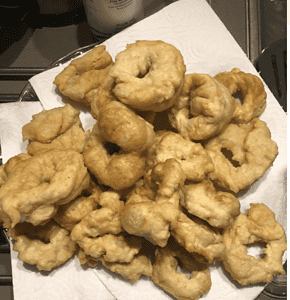
Flour: 500 g
Baker’s yeast: 30 g
Salt: ½ teaspoon
Warm water
Oil for frying
Method: Dissolve the yeast in a little warm water. Place the flour in a mixing bowl. Pour the dissolved yeast into the centre. Add the salt. Gradually add ¾ to 1 cup of warm water. Knead until you obtain a soft, light, and elastic dough. Add more water if necessary.
Cover the bowl with a clean cloth. You could cover it with plastic wrap, but firstly, I always saw my mother cover it with a cloth, and for me, that’s part of the tradition. Secondly, a cloth allows air to circulate, which should help the dough rise. Let it rest for 2 to 3 hours, until the dough has doubled in volume.
Heat the oil in a deep fat fryer. With oiled hands, take a ball of dough, make a hole in the centre with your thumb, and stretch it to form a circle. Drop it into the hot oil. Then repeat this process for the remaining doughnuts. Fry the doughnuts until golden brown on both sides. Once fried, place the doughnuts on paper towels to drain.
Be careful, the doughnuts tend to expand during frying, so make sure to space them out well in the fryer. Sfenjs are not supposed to be identical; they are often irregular and of different sizes.
Sfenjs are usually served warm, topped with powdered sugar, jam, honey, or a mixture of olive oil and honey or butter and honey, which are placed in small bowls on the table. They are generally served with mint tea.
Raquel Levy-Toledano is a genealogist specialising in Moroccan Jewry